“Hush, Little Baby” is a traditional lullaby built around a playful chain of gifts. Here is a familiar traditional public-domain version, followed by a few ways to make singing part of an easy bedtime routine. Folk versions differ, so the words your family remembers may be slightly different.
SleepA practical guide
Hush Little Baby lyrics: a traditional version for bedtime
Sing a familiar traditional version of Hush Little Baby, then use simple tips for an unhurried bedtime song and a clear, safe transition to sleep.
Jump to a section
The quick answer
The traditional “Hush, Little Baby” lullaby follows a chain of gifts, beginning with a mockingbird. The familiar public-domain words are below. Sing as few verses as you like; the song can be a gentle routine without promising sleep.
- Traditional versions differ between families and recordings.
- These are traditional lyrics, not a modern copyrighted adaptation.
- Humming or repeating a short section is enough.
- Keep bibs, blankets, and toys out of the infant sleep space.
Traditional Hush Little Baby lyrics
Hush, little baby, don't say a word,
Mama's gonna buy you a mockingbird.
And if that mockingbird don't sing,
Mama's gonna buy you a diamond ring.
And if that diamond ring turns brass,
Mama's gonna buy you a looking glass.
And if that looking glass gets broke,
Mama's gonna buy you a billy goat.
And if that billy goat won't pull,
Mama's gonna buy you a cart and bull.
And if that cart and bull turn over,
Mama's gonna buy you a dog named Rover.
And if that dog named Rover won't bark,
Mama's gonna buy you a horse and cart.
And if that horse and cart fall down,
You'll still be the sweetest little baby in town.
Why you may remember different words
Traditional songs travel through families and communities, so a parent might sing Papa instead of Mama, change the order of a gift, or remember a different ending. The Library of Congress holds a 1939 field recording of the song, reflecting its place in a living folk tradition.
You do not need to resolve every variation before singing. Choose the words that feel natural in your family and repeat the same gentle melody. This page presents a traditional version, not the lyrics of a modern recorded adaptation.
Fit it into a short bedtime sequence
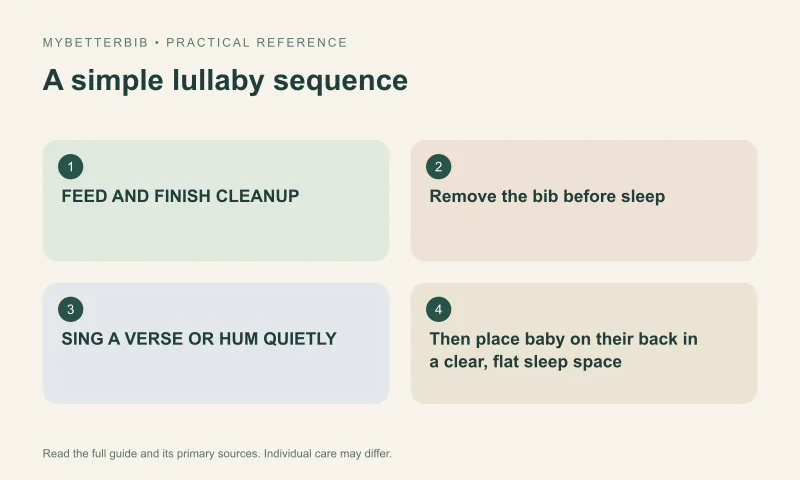
Choose a few repeatable steps that fit your evening: feed, necessary cleanup, a diaper change, sleep clothing, and a song. The order can reflect your baby's needs rather than a rigid performance.
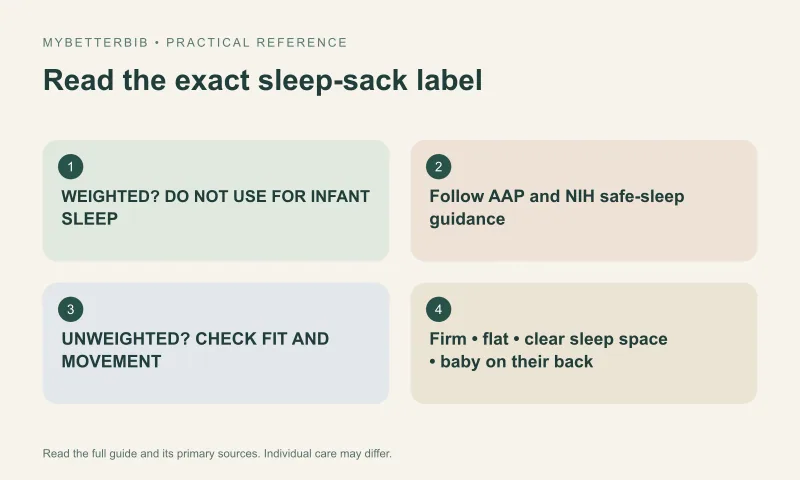
Keep feeding cloths and bibs out of the sleep space. When it is time for sleep, place the baby on their back on a firm, flat, appropriate infant sleep surface with only its fitted sheet. The NIH safe sleep environment guidance explains the setup.
Follow the rhyme chain when you forget a verse
The song works like a memory game. Each promised gift leads to the next when something goes wrong: the bird does not sing, a ring changes appearance, or an object breaks. You can remember the sequence as bird, ring, mirror, goat, cart, dog, and horse. The exact sequence varies across traditional performances, so a family version can be internally consistent without matching every recording.
Read the lyrics once before you begin holding the baby if that helps. When you lose your place, repeat the last verse or hum. There is no need to unlock a phone and search for the “correct” next line in the middle of a quiet moment. Repetition is part of what makes a familiar song easy for the adult as well as the child.
Hear the difference between tradition and an arrangement
The Library of Congress field recording is a primary historical resource for the song. Modern recordings may change wording, melody, accompaniment, or add newly written material. A traditional song and a particular artist’s recording are not the same thing, and a modern arrangement can have its own rights even when the underlying folk song is old.
For a family singalong, use the traditional words shown here or your own simple variations. If you are creating a video, album, or commercial recording, check rights to the specific arrangement and recording you intend to use rather than assuming every online version is freely reusable.
Adapt the routine to the caregiver and the baby
An adult can sing Mama, Papa, or another family name in the familiar pattern. A grandparent does not need to imitate the parent’s voice. Keep the volume comfortable and pay attention to whether the baby appears calmer or more stimulated. Some babies prefer a short song followed by quiet; others enjoy a longer awake-time singalong.
You can also use the song during a daytime cuddle without linking it to sleep at all. A sibling can choose the next gift or join the repeated lines while an adult handles the baby. The point is a shared interaction, not a performance the child must reward by becoming quiet.
Keep the ending practical on a tiring night
Before starting, finish any necessary feeding cleanup and remove the bib. Have the appropriate sleep space ready so you are not searching for supplies while holding a drowsy baby. If you feel yourself becoming sleepy on a couch or chair, place the baby in their own safe sleep space instead of trying to finish one more verse.
The NIH safe-sleep guidance calls for a firm, flat, clear infant sleep surface and back placement. A lullaby does not change that setup. If the baby continues crying, check needs and health rather than increasing the volume or adding more stimulation. One verse can be the whole ritual, and another caregiver can take over without making the evening a failure.
A few more details
Your questions, answered
Why do Hush Little Baby lyrics vary?
It is a traditional folk song passed between families and communities. Parent names, the gift sequence, and the ending can differ.
Do I have to sing the whole song at bedtime?
No. Sing a few verses or hum the melody if that suits your baby and your evening. The song is optional and does not guarantee sleep.
Can another caregiver change Mama to a different family name?
Yes. For a family singalong, a familiar family name or a simple variation can fit the traditional song. The caregiver does not need to imitate another person’s voice.
Is a modern recording automatically free to reuse?
No. A traditional public-domain song and a particular modern recording or arrangement are different works. Check rights to the specific version before publishing or using it commercially.
Sources & product information
Follow the original sources for current product details, instructions, and guidance.