To pick a baby name, generate ideas in a few deliberate categories, collect each parent’s favorites independently, and keep a short shared list. Research any cultural meaning you plan to use and check popularity only after you know which sounds you like.
NamesA practical guide
How to pick a baby name when you do not know where to start
Find baby name ideas through family stories, sounds, and personal preferences. Build a manageable longlist before making a final naming decision.
Jump to a section
The quick answer
To pick a baby name, generate ideas in a few deliberate categories, collect each parent’s favorites independently, and keep a short shared list. Research any cultural meaning you plan to use and check popularity only after you know which sounds you like.
- Generate ideas before trying to make the final decision.
- Create independent lists, then compare the overlap.
- Use SSA for popularity and separate reliable sources for meanings.
- Record why each name appeals to you.
A twenty-minute naming exercise you can repeat
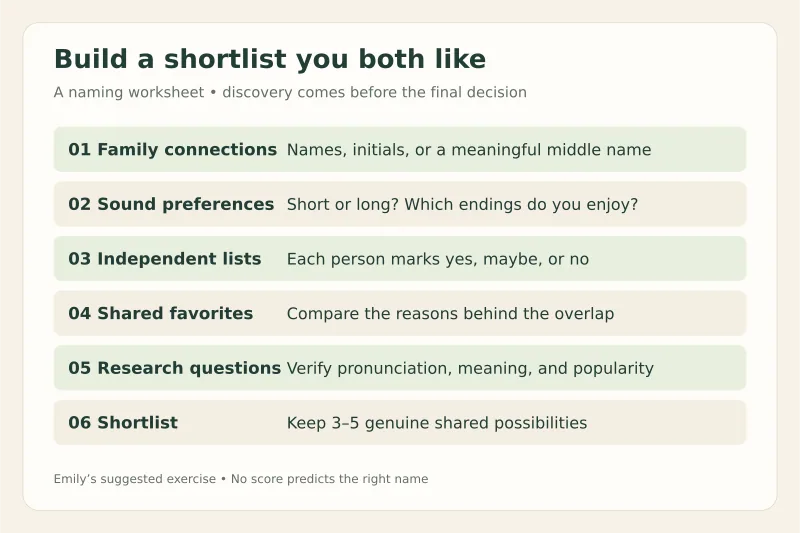
Take a sheet of paper and draw four boxes: family connections, sounds you like, longer names with nicknames, and fresh ideas. Spend five minutes filling each box without arguing about the entries. One person might write James or Alice under family connections; another might add a grandparent’s surname as a possible middle name. The exercise is about generating options, not assigning a winner.
Next, mark each entry yes, maybe, or no privately. Compare the yeses first. If there is no overlap, look at the underlying preferences: short versus long, familiar versus uncommon, soft consonants versus sharper sounds, or a wish to honor a relative. Those patterns give you a better next search than “more baby names.”
Work from concrete examples
Suppose one parent likes Theodore and Alexander because they allow short everyday forms, while the other likes Leo and Max because they are concise. The common preference may be a short spoken name, even though the written lists look different. You can discuss whether the formal version matters, then explore names with that shared quality.
Or suppose both parents want a family tribute but dislike the relative’s first name. You can consider the middle name, initial, surname, or a personally meaningful association. Be accurate about what the tribute represents; a newly chosen name does not need an invented linguistic meaning to justify the connection.
Keep a research note beside every uncertain claim
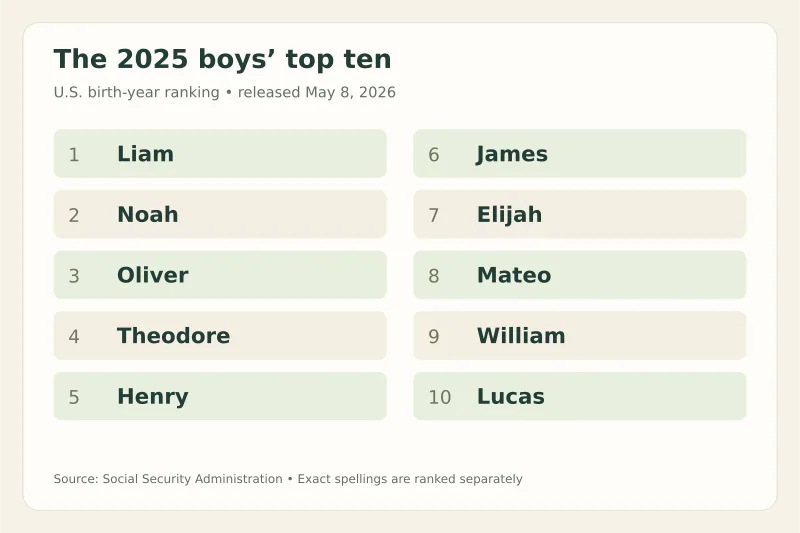
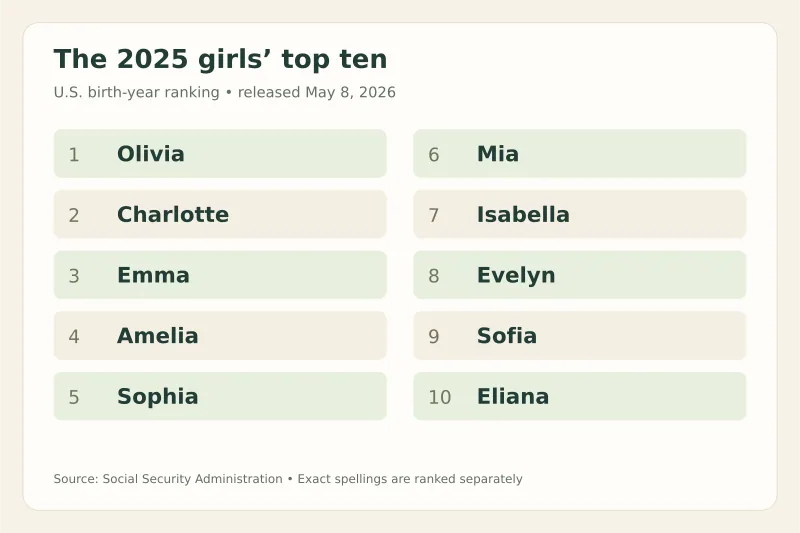
Use SSA’s official name tools for U.S. popularity, making sure you record the birth year and exact spelling. A social-media claim that a name is “unique” may ignore several alternative spellings or popularity in another country. Popularity is a descriptive fact, not a judgment of quality.
For pronunciation and meaning, consult sources appropriate to the language and culture involved. Ask a knowledgeable speaker how the name is ordinarily used, and distinguish an established meaning from your personal association. If reliable sources disagree, you can acknowledge that uncertainty rather than selecting whichever story sounds prettiest.
Build a shortlist document that helps you think
Use columns for the name, pronunciation, possible everyday form, full-name sound, family connection, and any unresolved question. Leave room for a private note about a strong association. Avoid numerical totals at this stage; a name with a serious shared objection should not win simply because it collected points for having convenient initials.
Keep the working list to roughly ten entries before the final narrowing stage. When a new idea appears, compare it with the current list rather than reopening hundreds of rejected options. Schedule another short conversation after a break. Naming tends to be easier when it has a boundary and is not an argument running in the background of every other preparation.
Know when to move from picking to choosing
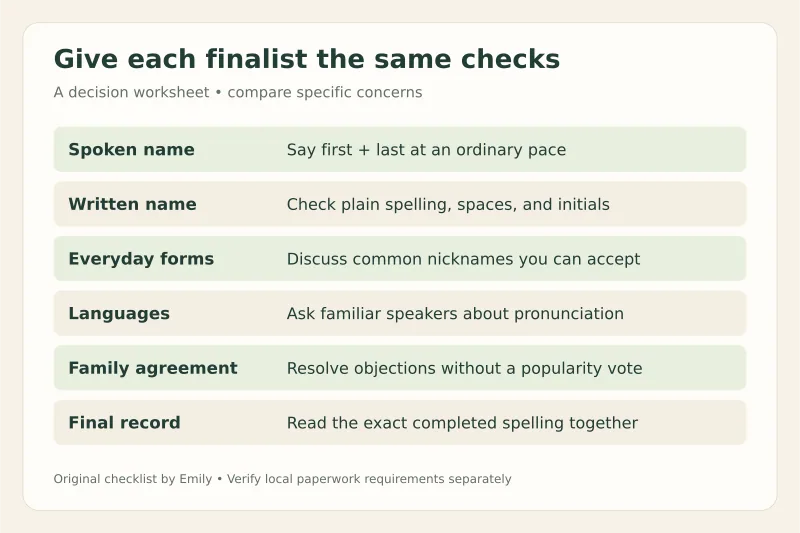
Once you have several names both decision-makers would use happily, stop collecting and start testing them. Say first and last together, check likely nicknames, and compare the final paperwork spelling. Our guide to choosing from a shortlist covers that second stage. Keeping discovery and final selection separate gives each conversation a clear purpose.
Collect ideas from several places
Make a list of names from family stories, local history, books, and people you admire. You are looking for possibilities, not borrowing someone’s entire identity. A name can appeal because of its sound even when it has no dramatic backstory.
Try browsing the SSA’s name database by different years or decades. Use it as a source of ideas and popularity context, not as a list of names you ought to choose. Older lists can remind you of familiar options that do not appear in every current conversation.
Notice the sounds you keep saving
Look at ten names you like and identify common features. Are they short or long? Do they begin with a soft sound or a sharp one? Do they have a familiar nickname? This can reveal a preference that is easier to discuss than “I just do not like it.”
Generate a second list using those patterns. If you like a long name but dislike its usual shortened form, consider whether another name gives you the same rhythm without that conflict. Do not assume you can control every nickname a child may eventually choose.
Check stories and meanings before repeating them
Name meanings online are often simplified or copied without context. If a cultural or linguistic connection matters, verify it through a reliable dictionary, specialist resource, or someone knowledgeable in that tradition. Avoid building your decision around an attractive meaning that no dependable source supports.
Family stories deserve the same care. Ask relatives how a name was spelled and pronounced, and whether there is history you should understand. Sometimes a middle name or related form offers the connection you want while fitting your household more naturally.
Turn your collection into a usable longlist
Limit the next round to about ten to fifteen serious ideas as a practical exercise. Keep extra possibilities in a separate note so the main list does not expand every day. Read the names with the surname, then remove only the ones that clearly fail your priorities.
Do not rush to score every option while you are still discovering your taste. When several names consistently feel right, move to a decision process. Our guide to choosing a baby name covers testing a shortlist, resolving disagreements, and making the final choice.
A few more details
Your questions, answered
Should I decide a name’s meaning before adding it to my list?
You can collect ideas first. Verify any meaning or cultural connection before making it a reason for your final choice.
What if our first lists have no names in common?
Compare the reasons behind your choices, such as a short spoken form or a family connection. Use that shared preference to generate a smaller new list.
Should friends vote on our baby name?
Only if you want that input. Private preference testing can be useful, but the decision belongs to the people choosing the name.
Sources & product information
Follow the original sources for current product details, instructions, and guidance.