Choose from a shortlist by checking the full spoken name, initials, common everyday forms, spelling, and any important family or language considerations. Resolve specific concerns together, then keep a backup instead of endlessly collecting more options.
NamesA practical guide
How to choose a baby name from your final shortlist
Use a calm, practical process to choose between baby names you already love. Compare full names, spelling, nicknames, and each parent’s priorities.
Jump to a section
The quick answer
Choose from a shortlist by checking the full spoken name, initials, common everyday forms, spelling, and any important family or language considerations. Resolve specific concerns together, then keep a backup instead of endlessly collecting more options.
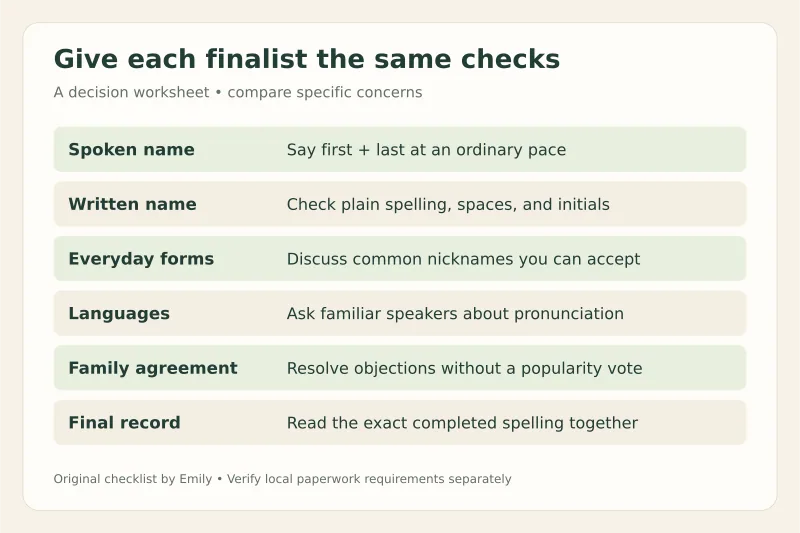
- Test first and last name together in ordinary speech.
- Check the actual spelling that would go on documents.
- Discuss likely nicknames without assuming you can control every use.
- A strong shared yes matters more than a numerical score.
Turn a shortlist into a decision sheet
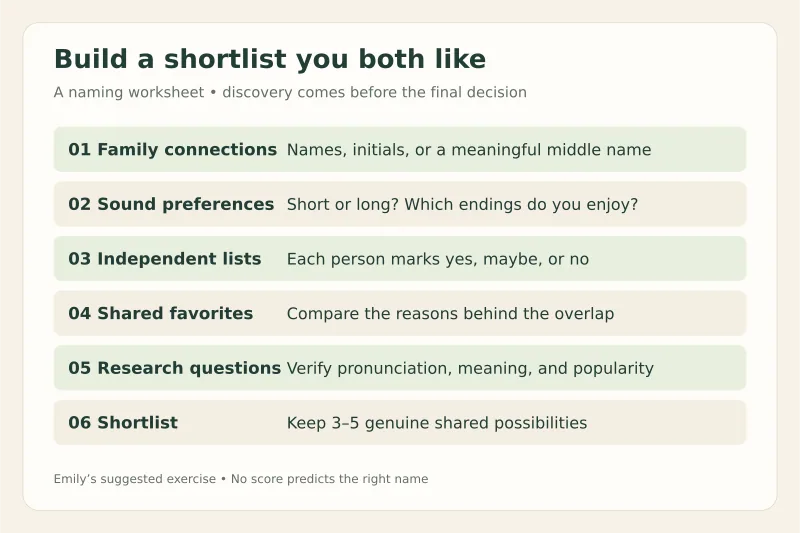
Create one row for each of three to five finalists. Add columns for first-and-last sound, full-name initials, preferred everyday form, pronunciation, personal connection, and an unresolved question. The point is to expose tradeoffs clearly, not turn affection into a contest with a mathematically correct result.
For example, Theodore James Martin offers a long formal first name and several shorter possibilities. Leo James Martin is shorter in writing and everyday speech. Neither is objectively better. If you like Theodore only when shortened to Theo, discuss whether you also want the formal name on school records and introductions. This sample is an illustration of a decision process, not a suggested name for every family.
Run five practical checks
Say it naturally. Read first and last at the pace you would use on a telephone call. Check whether the end of the first name merges with the beginning of the surname in a way you dislike.
Write it plainly. Look at the name in ordinary handwriting and typed text. Decorative script can make almost any name attractive but can hide spelling or spacing questions you should settle now.
Check initials and likely forms. Write the full initials and any common nickname beside the surname. Decide which possibilities you like and which you can comfortably accept even if they are not your first choice.
Ask the right language question. If multiple languages are used in the household, have trusted speakers read the name. Ask about normal pronunciation and established usage without demanding that one language be treated as a mistake.
Verify the administrative spelling. Agree on accents, spacing, hyphens, and middle names before completing records. Requirements differ by jurisdiction, so ask the relevant birth-registration office if a particular character or format matters; this article does not establish local naming law.
Separate a real concern from an impossible guarantee
You can check a current popularity ranking, but you cannot guarantee a future class will contain no child with the same name. You can choose an intuitive spelling, but you cannot prevent every mispronunciation. You can explain a preferred nickname, but the child may choose another form later.
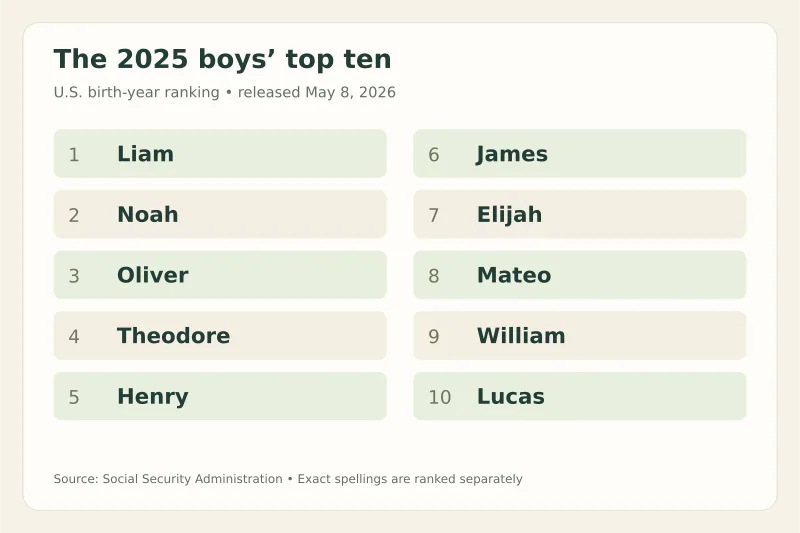
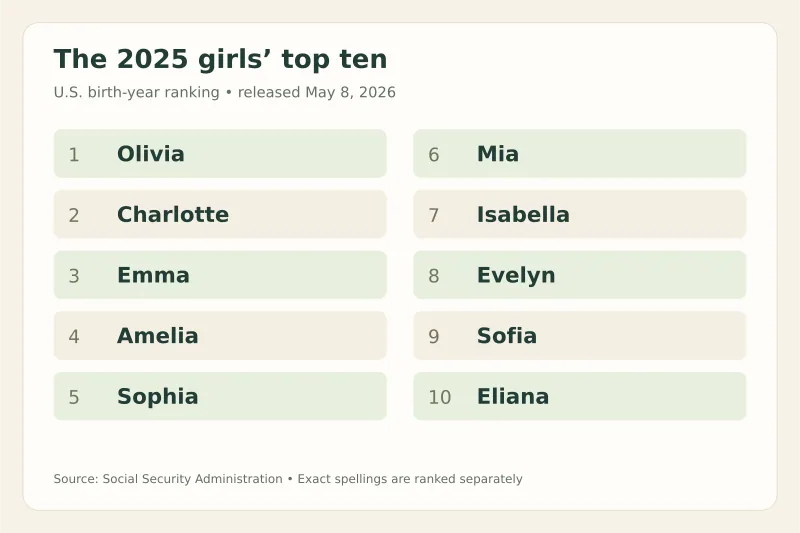
Use SSA’s name data to answer a concrete question about an exact spelling and birth year. Avoid using rank as a proxy for originality, social class, intelligence, or personality. Those inferences are not supported by the registry data.
Make disagreement specific and fair
Give each decision-maker space to say no to a name with a strong negative association. Then ask for a clear preference rather than a defense: “I want a familiar spelling,” or “I would like a middle name that honors my grandmother.” You may be able to meet both preferences without either person accepting a first name they dislike.
Once two names feel good to everyone, try them quietly for a few days. Keep one reserve if you want to decide after the birth. Before submitting documents, read the completed name aloud and compare the spelling together. That final check is more useful than another late-night list of a thousand possibilities.
Compare names against shared priorities
Choose a few criteria that reflect your family: pronunciation across languages, a family connection, a comfortable fit with the surname, or a spelling you both like. Write a short note for each name under each criterion.
For example, one option may be easy to pronounce but lack the family connection of another. That is a tradeoff to discuss, not a mathematical failure. If you use scores, treat them as conversation prompts. A name that wins by one point is not automatically the best emotional choice.
Try the full name in ordinary situations
Say the first and last name together, then include the middle name. Write the initials, the likely nickname, and the name on an imaginary birthday card. Check that the spelling you intend to register is the spelling you both have in mind.
Ask a trusted person to read it aloud if you want a practical pronunciation check. In a multilingual family, consult people who speak the relevant languages. You do not need unanimous approval, but you should understand any issue that would affect daily use before deciding how much it matters.
Separate preference from prediction
No name guarantees confidence, kindness, success, or a particular personality. Focus on what you can assess: sound, connection, spelling, and your willingness to use the name over time. Your child will bring their own associations to it.
If popularity matters, check the relevant year in the official SSA name data. Then decide what the result means for you. A national ranking cannot predict a future classroom, and inventing a new spelling does not necessarily make the spoken name less common.
Agree on a decision point and a backup
Choose a date to revisit the shortlist and stop collecting fresh opinions in the meantime. Some families prefer to decide before birth; others keep two options until they meet their baby. Either approach can work if everyone understands the plan.
Confirm the full spelling and name order together before completing official paperwork. Requirements and deadlines depend on your location, so follow the instructions provided by the hospital or relevant records office. Once you have chosen, you can share the news simply without inviting a new vote on the decision.
A few more details
Your questions, answered
Can we wait until after the birth to decide?
Many families keep a small shortlist, but paperwork deadlines and procedures vary. Ask the relevant registration office or hospital about your local process.
Should the highest-scoring name automatically win?
No. A checklist can reveal concerns, but a meaningful shared preference should not be overruled by an arbitrary point total.
Should we check the initials as well as the full name?
Yes. Write the full initials and likely everyday name beside the surname, then decide whether any combination causes a concern for your family.
Sources & product information
Follow the original sources for current product details, instructions, and guidance.