A baby jumper is optional entertainment equipment, not a necessary step toward walking. Products vary, especially between doorway-suspended jumpers and freestanding activity centers. Before buying, identify the exact type, understand its limits and consider whether supervised floor play already meets the need. Doorway designs deserve particular caution because their mounting and movement introduce additional risks.
Play2 products, compared
Baby jumper questions: do you need one, and what are the limits?
Understand baby jumpers, doorway risks and the difference from activity centers, then compare simpler play options and read the right product instructions.
Jump to a section
The quick answer
A baby jumper is optional entertainment equipment, not a necessary step toward walking. Products vary, especially between doorway-suspended jumpers and freestanding activity centers. Before buying, identify the exact type, understand its limits and consider whether supervised floor play already meets the need. Doorway designs deserve particular caution because their mounting and movement introduce additional risks.
- Fisher-Price Palm Paradise Jumperoo: a freestanding jumper to compare with floor play.
- Manhattan Toy Winkel: an easy-to-grasp rattle and teether.
- Use the exact model manual, including all size and developmental limits.
- Details come from manufacturer documentation; Emily has not claimed hands-on testing.
At a glance
The details that make a difference when you’re deciding.
| Product | Useful for | Detail to know | Before buying |
|---|---|---|---|
| Fisher-Price Palm Paradise Jumperoo | A freestanding jumper to compare with floor play | Freestanding frame with rotating seat | Large floor footprint |
| Manhattan Toy Winkel | An easy-to-grasp rattle and teether | Manufacturer age label: 0+ | Cleaning differs from many teethers |
A closer look
Products mentioned in this guide
Actual product photos, manufacturer information, and direct links. Comparisons are based on published specifications; these are not hands-on test results.
01
A freestanding jumper to compare with floor play
Fisher-Price / MattelFisher-Price Palm Paradise Jumperoo
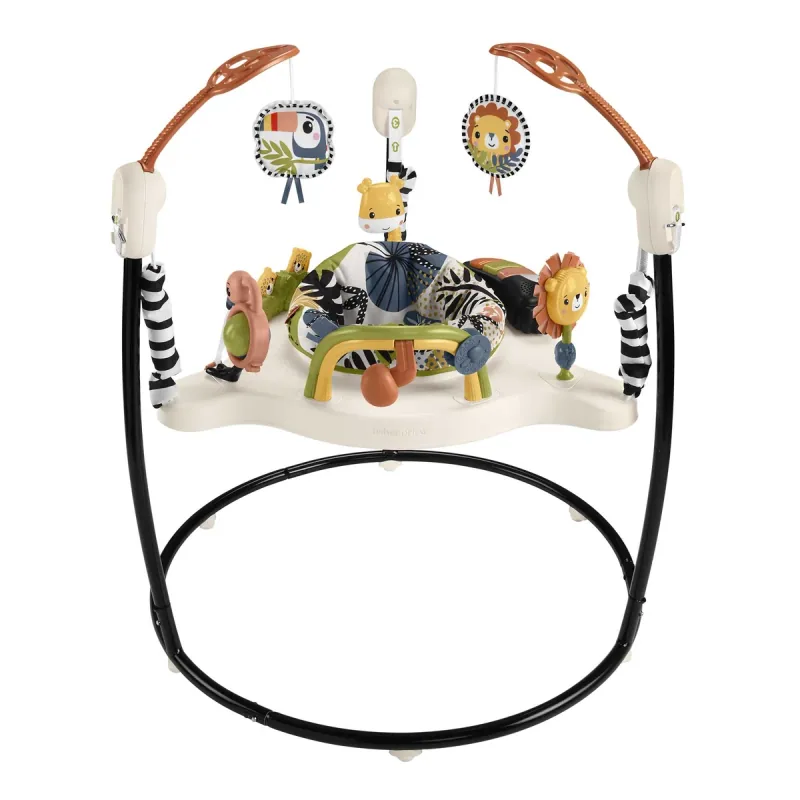
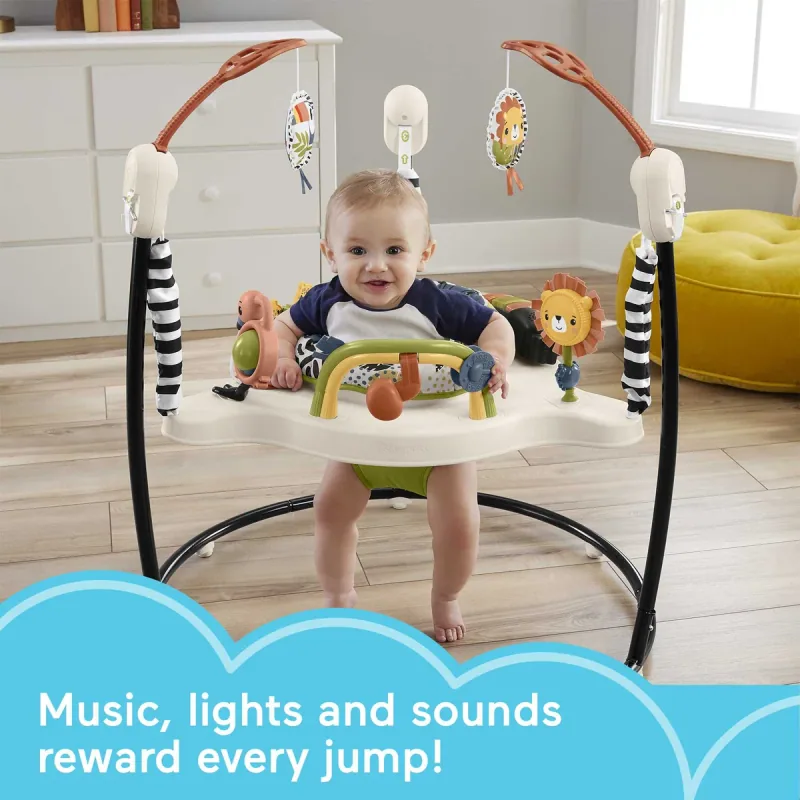
Palm Paradise is a freestanding activity jumper with a rotating seat and three height adjustments. It is optional entertainment, not equipment a baby needs in order to learn to walk. Mattel’s developmental requirement is explicit: the child must hold their head upright without assistance and must not be able to walk or climb out. The toy piano can be removed for separate play, which is a useful distinction from a permanently attached electronic panel. Inspect the spring covers, frame and seat before each session and follow the adjustment instructions.
- Freestanding frame with rotating seat
- Three height adjustments
- Removable toucan toy piano
- Maximum child weight: 25 lb
- Requires independent head control; stop before walking or climbing out
Where it fits
- No doorway attachment
- Removable toy for separate play
What to weigh up
- Large floor footprint
- Short supervised sessions; floor play remains important
02
An easy-to-grasp rattle and teether
Manhattan Toy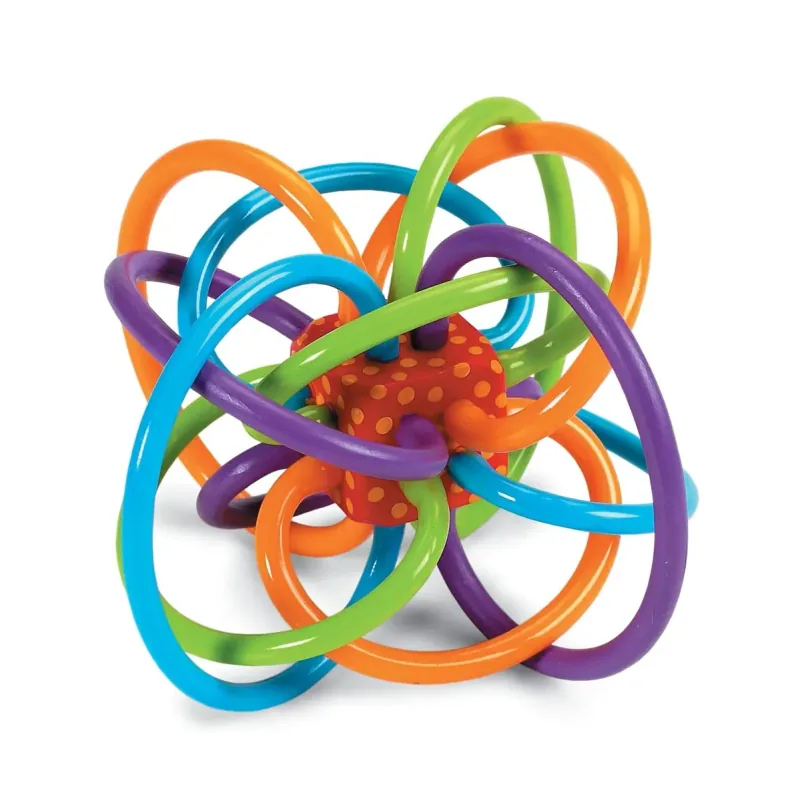
Manhattan Toy Winkel
Winkel uses soft intersecting loops around a central rattle, giving small hands several places to hold. It is an example of a toy with a specific job rather than a promise to accelerate development. The manufacturer allows refrigeration and gives unusually important cleaning restrictions: do not submerge it or put it in a steam sterilizer or microwave. That matters if you normally sanitize feeding items together. Offer it during supervised awake play, inspect the loops regularly, and follow the product directions rather than assuming every teether tolerates the same treatment.
- Manufacturer age label: 0+
- Flexible loops and central rattle
- Can be refrigerated as directed
- Surface-clean only; no submersion or steam sterilizing
Where it fits
- Multiple grasp points
- No batteries required
What to weigh up
- Cleaning differs from many teethers
- Inspect for damage before use
A freestanding jumper is optional play equipment
The Fisher-Price Palm Paradise Jumperoo is a specific example of a freestanding jumper: it has a rotating seat, toys around the frame and three height adjustments. Mattel lists a maximum child weight of twenty-five pounds and requires the child to hold their head upright without help, while not yet walking or climbing out. Those developmental conditions are more useful than a generic “six months” recommendation from another family.
For comparison, the Manhattan Toy Winkel is a small grasping toy that can be offered during supervised floor play. It does a different job and occupies very little storage space. Showing both makes the purchase decision clearer: you can support interesting play without a large piece of equipment, and a jumper is not a requirement for reaching a developmental milestone.
Measure the open equipment and the surrounding space
A freestanding jumper needs more than enough room for its feet. Leave clear space around the frame and toys, away from stairs, heaters and items the child might reach. Keep older children from climbing on or pushing it. Consider where it will live when not in use, particularly if you share a small living room with normal walking routes.
Read the assembly sequence carefully and verify that the seat fabric, springs or supports, and toys are attached as intended. Check height adjustment on every required point rather than changing only one side. If something seems asymmetric or does not lock correctly, stop and consult the manufacturer before placing the child inside.
Follow readiness and stopping rules every time
The calendar alone does not tell you that a baby is ready. Use the exact product’s head-control, size and other entry requirements. Similarly, reaching a new ability can end the use window before the weight limit is reached. Do not add pillows, folded blankets or an improvised platform to make an unsuitable child fit.
Keep sessions brief and supervised, and watch the baby’s response. A child who seems tired, uncomfortable or uninterested needs a change of activity rather than more stimulation. The jumper should not displace the floor time that lets a baby move freely in developmentally appropriate ways. Ask a clinician about concerns regarding movement or development instead of buying equipment as treatment.
Consider the toy features separately from the bouncing
Palm Paradise’s removable toy piano can be used away from the frame as directed. That is a practical feature if the child enjoys the toy but has outgrown or dislikes the seat. Check the separate age and battery instructions, inspect the compartment and keep replacement batteries inaccessible to children.
For smaller toys, read cleaning directions rather than putting everything through the bottle sterilizer. Winkel, for example, is surface-cleaned and should not be submerged or steam sterilized. The baby toys guide gives a small, concrete collection for different kinds of play. Buying fewer appropriate items can leave more space for the baby and caregiver to play together.
Separate the product categories
A doorway jumper suspends a seat from a doorway attachment. A freestanding jumper uses its own supporting frame. An activity center may support a child in a stationary seat without being intended for jumping. A wheeled walker is another category entirely.
Do not transfer advice between these products just because they all have seats with leg openings. Find the exact model and manual, and identify what moves, what supports the child and what keeps the frame stable. If a secondhand seller cannot provide the model information, you cannot confidently check those details.
Understand why doorway jumpers raise concerns
Australia's government product-safety authority advises against baby exercise jumpers, describing fall, impact and entrapment risks with doorway-suspended designs. Its exercise-jumper guide is useful safety context; its statements about Australian regulations should not be read as U.S. law.
A doorframe is also part of the setup, not simply a place to hang a toy. Trim dimensions, clamp compatibility and nearby obstacles matter. A visually secure attachment is not a substitute for following the exact product instructions.
Do not buy a jumper as a development shortcut
A product demonstration may show an enthusiastic baby bouncing, but that does not establish that the equipment teaches walking. Choose play around what your baby can comfortably do now, rather than trying to accelerate a milestone.
Offer supervised opportunities to reach, roll, sit when ready and explore on an appropriate floor surface. If you are concerned about movement, asymmetry or delayed skills, discuss the actual observations with your pediatrician. Buying another piece of equipment is not a substitute for an individualized assessment.
If you already own one, read before using
Check the minimum developmental requirements, maximum limits and setup instructions. Inspect the seat, straps, springs, attachment and frame as applicable. Keep other children from pushing or swinging the baby, and do not add toys or cords that were not approved for the product.
Use it only for awake, directly supervised play. Stop if the baby appears tired or uncomfortable, and never use it as a sleep space. Search the CPSC recall database with the exact model, especially for inherited or resale equipment.
Compare the simplest alternative
Ask what you hope the jumper will provide: a nearby place for play, a few minutes of entertainment or an activity that is easy to store. A small set of age-appropriate floor toys may answer that need without another large frame.
If you still want equipment, discuss the specific product with your clinician when relevant and read its instructions before purchase. You can skip a jumper entirely. Your baby does not need one to complete a registry or participate in ordinary play.
Store the identifying label and manual with the product record. If the seat fabric or a toy is damaged, ask the manufacturer for the exact replacement rather than using a similar part from another activity center. Stop using the equipment while a required component is missing or uncertain.
A few more details
Your questions, answered
Does a baby jumper help a baby learn to walk?
Do not buy one as a walking aid or development shortcut. If you are concerned about milestones, ask your pediatrician about your baby's specific development.
Is a doorway jumper the same as a stationary activity center?
No. Their support, movement and risks differ. Read the exact product instructions rather than transferring advice from another category.
What does Palm Paradise Jumperoo require before use?
Mattel requires independent upright head control and a child who cannot walk or climb out, with a twenty-five-pound maximum. Follow the exact manual’s complete fit and adjustment instructions.
Does a baby need a jumper to learn to walk?
No. A jumper is optional entertainment, not a developmental requirement or treatment. Keep supervised floor play and age-appropriate free movement part of the routine.
Sources & product information
Follow the original sources for current product details, instructions, and guidance.