Good baby toys match your child's current abilities, are intended for their age and invite simple interaction. You do not need a large collection or a toy for every milestone. Start with a few easy-to-clean choices for looking, reaching and exploring, and spend time playing together. The safety label matters more than a promise to make a baby smarter.
Play3 products, compared
Baby toys: a small, useful collection for everyday play
Choose baby toys for the skills your child uses now, with a simple rotation plan, sensible cleaning questions and attention to age labels and small parts.
Jump to a section
The quick answer
Good baby toys match your child's current abilities, are intended for their age and invite simple interaction. You do not need a large collection or a toy for every milestone. Start with a few easy-to-clean choices for looking, reaching and exploring, and spend time playing together. The safety label matters more than a promise to make a baby smarter.
- Manhattan Toy Winkel: an easy-to-grasp rattle and teether.
- Fisher-Price Sensory Rock-a-Stack: grasping and stacking from the labeled age.
- HABA Snug Up Doll Luisa: a first fabric doll for awake play.
- Details come from manufacturer documentation; Emily has not claimed hands-on testing.
At a glance
The details that make a difference when you’re deciding.
| Product | Useful for | Detail to know | Before buying |
|---|---|---|---|
| Manhattan Toy Winkel | An easy-to-grasp rattle and teether | Manufacturer age label: 0+ | Cleaning differs from many teethers |
| Fisher-Price Sensory Rock-a-Stack | Grasping and stacking from the labeled age | Age label: 6 months and older | Related versions have different age labels |
| HABA Snug Up Doll Luisa | A first fabric doll for awake play | 8-inch first doll | Not an infant sleep companion |
A closer look
Products mentioned in this guide
Actual product photos, manufacturer information, and direct links. Comparisons are based on published specifications; these are not hands-on test results.
01
An easy-to-grasp rattle and teether
Manhattan ToyManhattan Toy Winkel
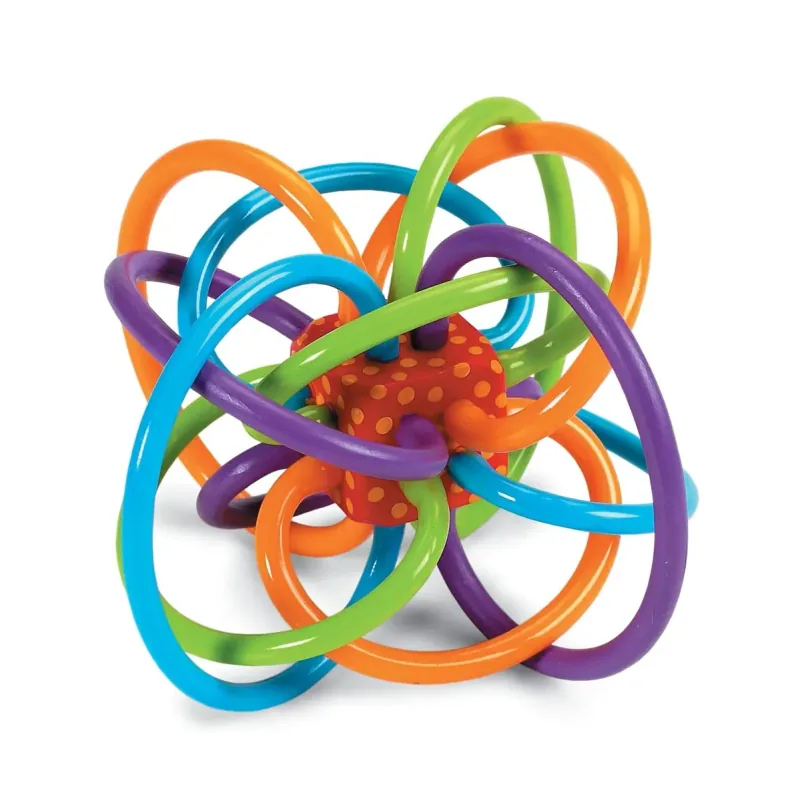
Winkel uses soft intersecting loops around a central rattle, giving small hands several places to hold. It is an example of a toy with a specific job rather than a promise to accelerate development. The manufacturer allows refrigeration and gives unusually important cleaning restrictions: do not submerge it or put it in a steam sterilizer or microwave. That matters if you normally sanitize feeding items together. Offer it during supervised awake play, inspect the loops regularly, and follow the product directions rather than assuming every teether tolerates the same treatment.
- Manufacturer age label: 0+
- Flexible loops and central rattle
- Can be refrigerated as directed
- Surface-clean only; no submersion or steam sterilizing
Where it fits
- Multiple grasp points
- No batteries required
What to weigh up
- Cleaning differs from many teethers
- Inspect for damage before use
02
Grasping and stacking from the labeled age
Fisher-Price / Mattel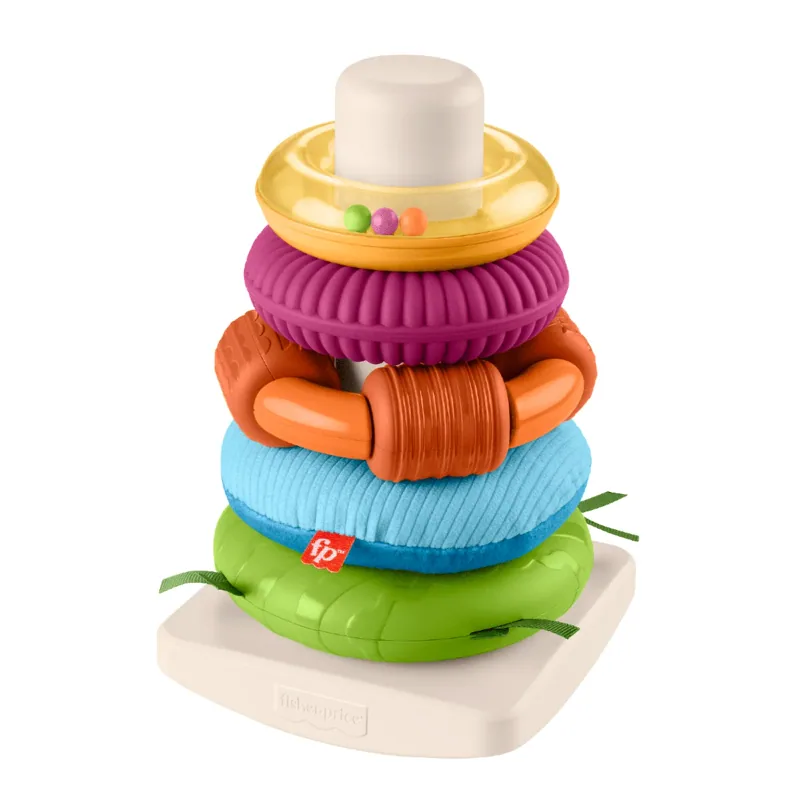
Fisher-Price Sensory Rock-a-Stack
Sensory Rock-a-Stack combines a wobbly base with five rings that offer different textures and activities. For a baby just learning to grasp, playing with one ring can be enough; the child does not need to stack them correctly to enjoy the toy. Later, you can model taking turns, placing one ring on the post and naming colors during play. Check the 6-month age label rather than confusing it with the wooden or giant versions of the same toy family. Those related products can have different minimum ages.
- Age label: 6 months and older
- Five sensory rings
- Roly-poly base
- Textures, fabric and rattling elements
Where it fits
- Several ways to explore one toy
- No screen or app required
What to weigh up
- Related versions have different age labels
- Keep loose rings out of sleep spaces
03
A first fabric doll for awake play
HABA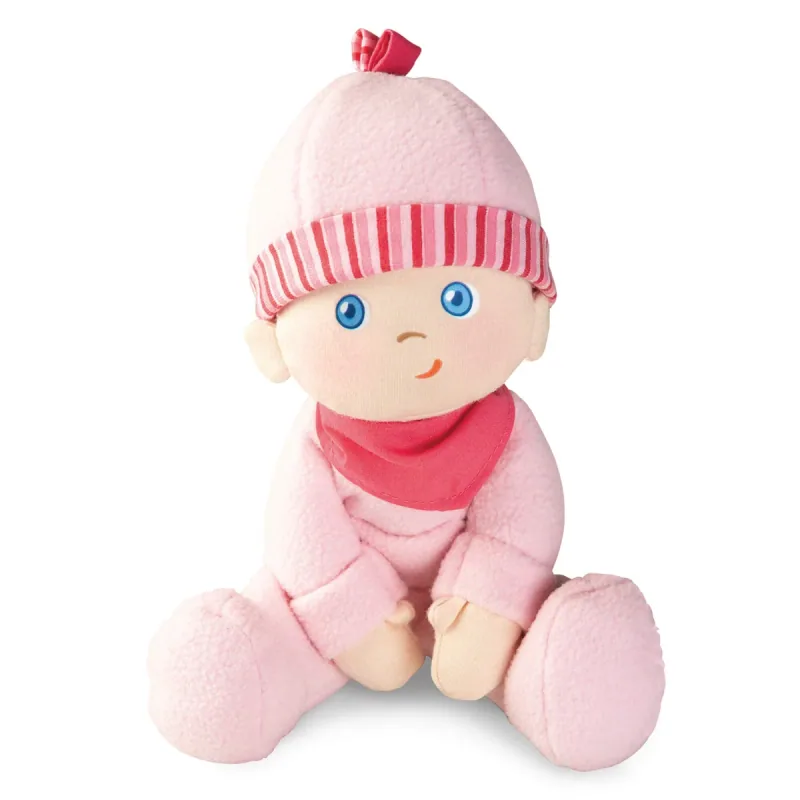
HABA Snug Up Doll Luisa
Luisa is an eight-inch fabric doll with printed features and a sewn-on outfit. That gives a different play experience from a heavy realistic collectible: a baby can hold the soft body without managing removable doll shoes or tiny outfit fasteners. HABA labels it for newborns and up, but that age label does not mean it belongs in an infant’s crib. Use it during awake play and put it away before sleep. The manufacturer allows a cold delicate machine wash and asks owners to air dry rather than tumble dry.
- 8-inch first doll
- Manufacturer age label: newborn and up
- Printed face and attached outfit
- Machine wash cold/delicate; do not tumble dry
Where it fits
- Soft and light for little hands
- Simple washing routine
What to weigh up
- Not an infant sleep companion
- No removable outfit for dressing practice
A small collection with three specific jobs
The Manhattan Toy Winkel gives a baby multiple soft loops to grasp and a gentle central rattle. Fisher-Price Sensory Rock-a-Stack, labeled for six months and older, offers five rings with different textures and a wobbly base. HABA Snug Up Doll Luisa is a small fabric doll for holding and early social play. These examples give you distinct activities without filling the room with several toys that all light up and make sounds.
Use the age label as a starting requirement and match the activity to the child in front of you. A younger baby might simply hold one ring rather than stack it. A caregiver can move a grasping toy slowly within the baby’s comfortable view or take turns offering and receiving a fabric doll. There is no need to turn play into a test of whether the toy’s advertised skill has appeared.
Check model names when a classic toy has many versions
“Rock-a-Stack” can refer to a classic plastic stacker, a sensory version, a larger version or a wooden toddler version. The number and material of the pieces and the minimum age can differ. The product card above identifies the Sensory Rock-a-Stack, not every toy sold under that family name. Check the actual packaging if a relative buys it through another retailer.
The same principle applies to first dolls. Luisa’s newborn-and-up label does not transfer to every HABA doll or to its accessories. A separately sold outfit, bottle or stroller can have an older age recommendation. Store older siblings’ small toy pieces where an infant cannot reach them.
A practical weekly toy rotation
Keep a few suitable items within the caregiver’s reach and store the rest. Offer one or two at a time, observe what holds interest, and put them away before the sleep routine. Rotate when the baby seems ready for variety rather than on a rigid calendar. Repetition is part of play; a familiar toy can remain interesting when the child discovers a new way to hold, drop or explore it.
Use a washable container for clean toys and another place for items that need attention. Avoid overfilled bins that hide broken pieces at the bottom. Inspect seams, loops, rings and battery covers during cleanup, particularly after a toy has been dropped or chewed.
Cleaning instructions can change the buying decision
Winkel may be refrigerated as directed, but the maker says not to submerge it, microwave it or put it in a steam sanitizer. Luisa can be machine washed on a cold delicate cycle and air dried. A single cleaning routine for both products would therefore be inappropriate. Read the instructions before adding a toy to your regular bottle-washing or laundry system.
Choose toys whose care you can realistically maintain. Keep all toys out of an infant’s sleep space, even when a package labels a soft doll suitable from birth. For more substantial pretend-play choices as a child grows, see the baby doll guide. The value of a toy comes from suitable, enjoyable play, not the length of its developmental promises.
Choose for today's play
For a baby who is mainly looking and listening, a caregiver's face, conversation and a suitable high-contrast toy can be enough. As reaching and grasping emerge, choose toys that are easy to hold and intended for that stage. Later, simple containers, sturdy board books and larger stacking pieces can offer new ways to explore.
Treat age ranges as safety guidance, not a competition. A toy labeled for older children may contain parts or mechanisms that are unsuitable for a younger baby even if the baby appears interested. Development varies, so watch what your child can comfortably do and choose accordingly.
Check the parts, not only the packaging
Look for a clear manufacturer, age label and care instructions. Examine seams, attachment points and any battery compartment. Keep toys with small detachable components away from children who mouth objects, including when the toys belong to older siblings.
CPSC explains how small-parts and choking-hazard rules apply to young children's products. A homemade size comparison is not a complete safety assessment; follow labels and avoid assuming that an unlabeled marketplace listing has been evaluated for infant use.
Build a compact toy rotation
Choose a small group with different kinds of interaction: something to look at, something to grasp and a sturdy book or simple object to explore together. Keep the rest out of sight and rotate when interest changes. This is an organizational choice, not a required developmental program.
Notice how the baby uses a toy before replacing it. A familiar item may become interesting again when a new skill emerges. You can describe its color, move it slowly within reach or take turns holding it without needing a special activity kit.
Make cleaning realistic
Read whether a toy can be wiped, washed or submerged. A fabric toy with electronics requires different care from a one-piece washable item. Let toys dry fully according to their instructions, and inspect them after cleaning for damage.
Keep a small container for toys that need attention so they do not immediately return to the play area. Check borrowed and secondhand toys just as carefully as new ones. Search current recalls using the brand and model when available, and discard or follow the remedy for unsafe products rather than passing them on.
Keep toys out of infant sleep spaces
Play toys belong in awake-time areas. Do not leave stuffed animals, soft toys or loose objects in an infant's crib or bassinet. The AAP's nursery safety checklist also highlights the need to keep reachable hazards away from the sleep space.
For gifts, ask about the baby's stage and the household's space before buying a large toy. A well-chosen book or small, durable toy can be easier to use than a noisy activity station. The most helpful collection is one caregivers can inspect, clean and enjoy with the baby.
A few more details
Your questions, answered
How many toys does a baby need?
There is no required number. A small set of age-appropriate toys and regular interaction with caregivers can provide plenty of opportunities for everyday play.
Can a baby sleep with a soft toy?
Keep soft toys and loose objects out of an infant's sleep space. Use toys during supervised awake time instead.
Can Winkel go in a bottle sterilizer?
No. Manhattan Toy says not to submerge Winkel or use a sanitizer, steamer or microwave. Follow its surface-cleaning directions; refrigeration is permitted as directed.
Are all Rock-a-Stack toys for the same age?
No. The Sensory version pictured here is labeled six months and older. Wooden, giant and other versions can have different age requirements, so check the exact product.
Sources & product information
Follow the original sources for current product details, instructions, and guidance.