Baby sign language means pairing useful gestures or signs with everyday communication before a child can say all the words they want. Begin with a few meaningful ideas, keep speaking naturally, and treat the activity as shared play. It is optional, and it does not need to become another milestone test.
CareA practical guide
Baby sign language: a simple way to begin everyday gestures
Start baby sign language with a few useful signs, spoken words, and everyday routines. Keep practice playful and share the same approach with caregivers.
Jump to a section
The quick answer
Start baby signing with a few useful words such as milk, more, and all done. Pair each sign with normal speech in the relevant moment, accept imperfect attempts, and never withhold food or comfort until the baby signs.
- Choose useful everyday signs rather than a large vocabulary list.
- Learn ASL signs from fluent signers or qualified teaching resources.
- A few baby signs are not the same as learning a complete sign language.
- Hearing or communication concerns deserve assessment, not a wait for signing to work.
Pick words that appear in your day
Milk, more, all done, help, and book may be useful starting points because they connect to things a baby regularly experiences. Your best first choices depend on your household, not a list of impressive vocabulary.
The AAP's introduction to baby signing recommends useful everyday signs, repetition, and continuing spoken interaction. It also encourages realistic expectations; watching a parent demonstrate a sign and producing it independently are different stages.
Choose two or three ideas first. A short list lets every adult remember the same meanings without consulting an app during every meal.
Connect the sign with the real moment
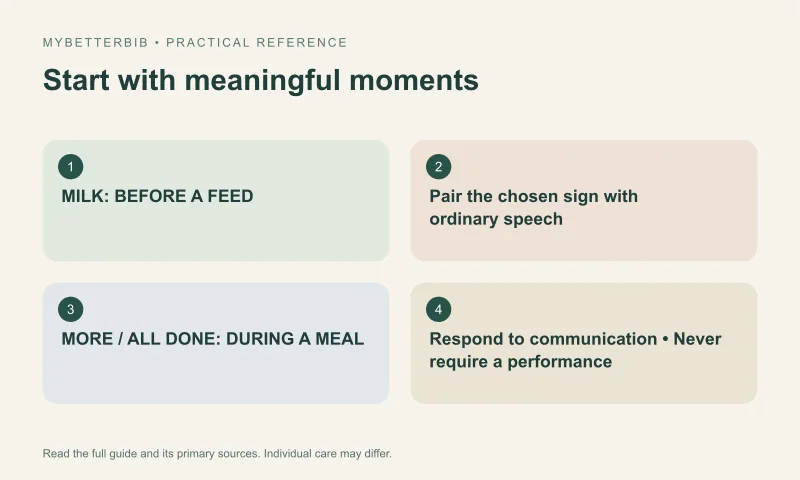
Say the word while making the sign when the object or action is relevant. For example, use the chosen sign for milk before a feed, or book when you sit down together with a board book.
Pause to give your baby space to respond through looking, reaching, sounds, or a gesture. Respond warmly to the attempt without demanding a perfect hand shape.
Do not withhold food, comfort, or help until your baby performs a sign. Communication works better when the child experiences it as useful, not as an entry requirement for having a need met.
Observe communication as a whole
Notice eye contact, sounds, pointing, gestures, and the back-and-forth of interaction rather than counting signs alone. Enjoy the exchange even if your baby never becomes an enthusiastic signer.
If you have concerns about hearing, loss of skills, or communication development, speak with your pediatrician rather than waiting for signing to resolve them. Keep conversation, reading, and responsive play part of the day. The point is a richer connection, with another small way to understand each other.
A small first-week routine
Pick two moments that already repeat: a milk feed and the end of a meal, for example. Learn the signs you want to use from a clear demonstration, then use them naturally with the spoken words. One brief demonstration at the relevant moment is enough; you do not need to turn every feed into a lesson.
For the next few days, repeat those same signs when the situation occurs. Watch for looking, reaching, changes in expression, or an approximate gesture. Respond to the meaning you understand, even if the hand shape is different. If your baby shows no interest, continue normal talking and care. The activity is optional and should not make meals or comfort harder to access.
Use authentic demonstrations for the signs themselves
American Sign Language includes movement, location, facial expression, and grammar. A still drawing of hands can omit information, so a reputable video demonstration is often more useful than copying a random image. Gallaudet University’s ASL Connect is a starting point for learning about ASL from a university centered on Deaf education and language.
For direct demonstrations, ASL University provides MILK, MORE, and FINISH / all done. Watch the movement and facial expression as well as the hand shape. Use milk before a feed, more when offering an appropriate extra amount, and all done when an activity ends. Save these three links in the caregiver note instead of expecting everyone to interpret a still drawing. The demonstrations teach the signs; your daily routine supplies the meaningful context.
Keep a direct link to the chosen demonstration in a shared caregiver note. If adults use different versions of a sign, decide on a consistent version for the routine while recognizing that natural languages have variation. Do not describe a few borrowed gestures as a complete ASL program or promise that baby signing creates a particular language advantage.
Make a caregiver note with examples, not tests
A short note might say: “Milk: demonstrate before the feed while saying milk. More: use during a meal when offering an appropriate additional amount. All done: use as the activity ends.” Include the video source rather than an invented written hand description. Let caregivers use their ordinary spoken language alongside the shared gesture.
Avoid requiring the baby to perform on demand for visitors. A child who signs at breakfast may not sign in a noisy room with unfamiliar adults. Responding to communication in context is more useful than counting successful demonstrations. If a sign becomes frustrating, set it aside and keep the exchange playful.
Keep wider development in view
Listen for sounds, notice back-and-forth attention, and observe how the child responds to familiar voices and environmental sounds. The NIDCD communication checklist offers age-related information to discuss with the pediatrician. It is broader than counting gestures or spoken words alone.
If there is concern about hearing, loss of a skill, or communication development, request assessment. Do not wait several months to see whether signing fixes the concern. Deaf and hard-of-hearing babies need timely access to language and appropriate support; a casual list of baby signs should not delay those services. Ask the care team about local early-intervention resources and the communication options relevant to your family.
A few more details
Your questions, answered
Should I stop talking while using baby signs?
No. Pair signs with normal spoken interaction. Signing should add a communication option, not remove conversation.
Does my baby have to sign before getting more food?
No. Respond to hunger and other needs without requiring a sign. Model the sign naturally and keep the interaction positive.
Do I need to teach the ASL alphabet first?
No. A few meaningful everyday signs can fit a baby routine. Learn the actual signs from reliable demonstrations and continue normal spoken interaction.
Are a few baby signs the same as learning ASL?
No. ASL is a complete language with its own grammar and cultural context. A few everyday signs can support a family routine without constituting a full ASL education.
Sources & product information
Follow the original sources for current product details, instructions, and guidance.